Dependable Three-Hour Emergency Lighting
Signify Ecolink standalone emergency fittings are designed to provide essential illumination when the normal lighting supply fails. Each fitting contains its own rechargeable LiFePO4 battery and delivers up to three hours of emergency operation when correctly installed and maintained.
The range offers four different fitting styles, allowing emergency lighting to be selected according to the building layout, environmental conditions and required light distribution.
Suitable applications may include:
- Offices and commercial buildings
- Warehouses and industrial premises
- Communal corridors and stairways
- Retail and hospitality environments
- Car parks and service areas
- Public buildings and shared facilities
- Escape routes and final exits
Emergency lighting should form part of a properly designed system based on the premises, its fire-risk assessment and the applicable requirements.
Choose the Right Emergency Fitting
Each Ecolink fitting serves a different purpose. The correct option should be selected according to the area requiring illumination rather than wattage alone.
Fitting | Emergency output | Beam angle | IP rating | Typical role |
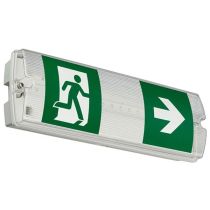
3W emergency bulkhead | 150lm | 180° | IP65 | Escape routes, final exits and general emergency illumination |
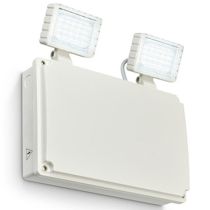
9W emergency twin spot | 2 × 500lm | 240° | IP65 | Warehouses, open areas, industrial spaces and higher mounting positions |
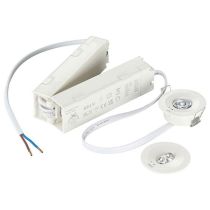
1W recessed emergency spot | 120lm | 60° | IP20 | Discreet emergency lighting in dry indoor ceilings |
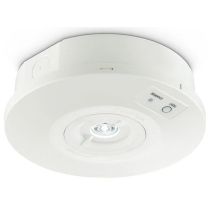
2W surface emergency spot | 250lm | 90° | IP20 | Dry indoor areas where recessed installation is unsuitable |
These applications are general guidance. The number, positioning and type of emergency fittings must be determined as part of the complete emergency-lighting design.
Emergency Bulkhead Lighting
The 3W Ecolink emergency bulkhead provides 150 lumens with a broad 180-degree beam. Its IP65 enclosure offers protection against dust and water jets, making it suitable for many indoor and more demanding locations when correctly installed.
A legend kit is included, allowing the bulkhead to support appropriate escape-route or exit identification where the supplied legend and installation are suitable for the building.
The bulkhead can also provide general emergency illumination without a legend. Its precise use and mounting position should be confirmed by the emergency-lighting designer or installer.
High-Output Emergency Twin Spot
The 9W twin spot is the highest-output fitting in the category, producing two 500-lumen beams. Its two adjustable heads allow the emergency illumination to be directed towards the areas where it is most needed.
This makes it particularly useful for:
- Warehouses and industrial premises
- Larger open areas
- Plant and equipment rooms
- Loading or service areas
- High-ceilinged commercial spaces
- Covered parking and circulation areas
The twin spot is rated IP65, providing increased protection against dust and moisture compared with the two IP20 spot options.
Recessed Emergency Spot
The 1W recessed spot offers a discreet emergency-lighting solution for suitable dry indoor ceilings. Only the compact light head remains visible once installed, helping maintain a clean ceiling appearance in offices, corridors, hotels and other finished interiors.
It produces 120 lumens through a focused 60-degree beam. Its IP20 rating means it is intended for dry indoor areas and should not be used where protection against moisture or dust is required.
Ceiling void space, cut-out requirements and access to the battery and control equipment must be considered before installation.
Surface-Mounted Emergency Spot
The 2W surface spot provides 250 lumens with a 90-degree beam. It offers a practical solution where recessed installation is unavailable or unsuitable, such as solid ceilings or locations without an accessible ceiling void.
It is rated IP20 and is therefore intended for dry indoor environments. For damp, dusty or more demanding locations, the IP65 bulkhead or twin spot may provide a more appropriate starting point, subject to the lighting design.
What Does Three-Hour Emergency Lighting Mean?
Three-hour emergency lighting is designed to continue operating from its internal battery for up to three hours after the normal mains supply fails, provided the battery is fully charged and the fitting is correctly maintained.
This does not necessarily mean that every building must remain occupied for three hours. The required emergency duration depends on the building, how it is used and the relevant fire-safety assessment.
Emergency fittings require a permanent electrical supply to keep their batteries charged. They should not be connected in a way that prevents normal charging.
IP20 or IP65 Emergency Lighting?
The appropriate IP rating depends on the environment in which the fitting will be installed.
IP20 fittings are intended for dry indoor areas. Within this range, the recessed and surface-mounted emergency spots are rated IP20.
IP65 fittings have a dust-tight enclosure and protection against water jets. The emergency bulkhead and twin spot are rated IP65, making them more suitable for dusty, damp or demanding environments.
IP65 does not mean a fitting can be submerged. Its mounting position, exposure and installation must still be suitable for the conditions at the site.
Bright 6500K Emergency Illumination
All four fittings produce 6500K daylight-coloured illumination. Emergency lighting is selected primarily for visibility, coverage and safety rather than for decorative ambience.
The bright white appearance helps distinguish emergency illumination when the normal lighting fails and supports visibility along escape routes and within open areas.
The products are not intended to replace the building’s everyday general lighting.
LiFePO4 Battery Technology
Ecolink standalone emergency fittings use rechargeable lithium iron phosphate, or LiFePO4, batteries. These batteries are designed to provide dependable emergency operation while the fitting remains connected to its permanent charging supply.
Like every rechargeable emergency-lighting battery, performance can reduce over time. Regular testing helps identify whether the fitting still delivers the required emergency duration.
The entire emergency-lighting system should be inspected and maintained at the appropriate intervals, with results recorded in the premises’ emergency-lighting logbook.
Maintained and Non-Maintained Operation
A maintained emergency light remains illuminated during normal mains operation and continues from its battery if the supply fails. A non-maintained fitting normally remains off and illuminates only during a mains failure.
The exact operating mode and wiring capabilities of each Ecolink fitting should be checked against its current installation instructions before ordering. The product title alone should not be used to determine how it must be wired.
Installation must be completed by a suitably qualified professional.
Emergency Lighting Design and Testing
Emergency lighting is a life-safety system. Selecting fittings solely by room size or replacing old fittings on a one-for-one basis may not produce adequate coverage.
A competent emergency-lighting professional should determine:
- The areas and escape routes requiring illumination
- The required emergency light levels
- The number and position of fittings
- Whether exit legends or signs are required
- The appropriate beam pattern and output
- The required IP rating
- Testing and maintenance arrangements
- Compatibility with the premises’ fire-risk assessment
Emergency lighting should be tested and maintained routinely so that battery operation, charging indicators and light output remain dependable.
The Lightsave Home Advantage
Lightsave Home combines competitive Ecolink pricing with support from an experienced UK lighting supplier. The four-fitting range provides options for discreet indoor installations, exit and escape-route applications, and higher-output emergency coverage.
- Three-hour emergency operation
- LiFePO4 rechargeable batteries
- Bulkhead, twin-spot and compact spot options
- IP20 and IP65 fittings
- Outputs from 120 to 1,000 lumens
- Five-year manufacturer’s warranty
- Convenient UK delivery
- Secure online ordering or collection from our Reading trade counter
If you need help comparing the available fittings, contact our lighting team. Final system design and installation should always be handled by a suitably qualified professional.